 Collector: Christina Chontos-Fisher
Artist: Jay Kelly - Greenman Tattoo
West Hartford, Connecticut
Collector: Christina Chontos-Fisher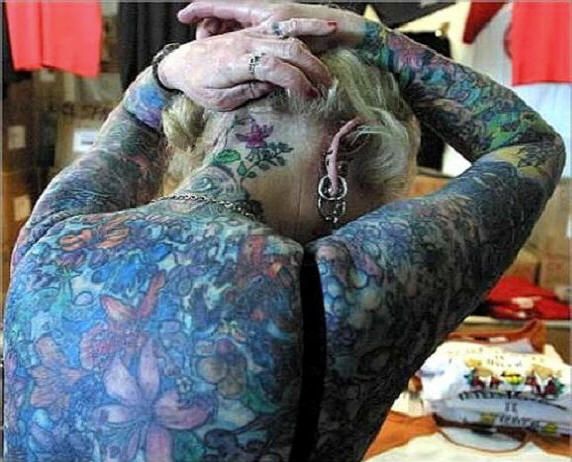 Full Body Tattoos
 Full Body Tattoos
 Full Body Tattoos
It history of art to tattoo goes back to over two thousand years. In initial years the practice to tattoo was employed in order to it punishment for the transgressors of the law. This would label the individuals who would be identified like outlaws of the company. In fact Japan was the last country to remove the practice to tattoo punitive.
With time this practice had produced a group of outlaws with marks of tattooings showing their violation of law. Such individuals then started to resort to full tattooings of body in order to hide their shame. For this purpose the artists of tattooing derived a range from decorative tattooings which would be pressed everywhere the body.
Mehndi, when applied to the hands, is a very intricate pattern that resembles a tattoo, and it can extend up the arms to the elbow as well as from the foot to above the ankle in bridal mehndi. The color ranges from a light red-orange to nearly black.
When looking at the picture, remember that the pictures with the black or green design are with the paste on, and the red-brown designs are with the paste removed. You should not be hesitant to get mehndi if you have dark-colored skin. If your skin is very dark, you should perhaps try to get mehndi done on your palms at first, or do a small design and take very good care of it. See the results before you decide to go big. Even with people who have light skin, mehndi can come out with a bad color, even though these days most every henna should stain the skin very well.
At first glance after removing the dried paste, the mehndi stain will appear to be a very light, almost neon orange at times (or a red brown). Whatever the case may be, your design will darken drastically over the next 24 hours, so be sure not to wash your hands and watch this interesting process take place.
Mehndi, when applied to the hands, is a very intricate pattern that resembles a tattoo, and it can extend up the arms to the elbow as well as from the foot to above the ankle in bridal mehndi. The color ranges from a light red-orange to nearly black.
When looking at the picture, remember that the pictures with the black or green design are with the paste on, and the red-brown designs are with the paste removed. You should not be hesitant to get mehndi if you have dark-colored skin. If your skin is very dark, you should perhaps try to get mehndi done on your palms at first, or do a small design and take very good care of it. See the results before you decide to go big. Even with people who have light skin, mehndi can come out with a bad color, even though these days most every henna should stain the skin very well.
At first glance after removing the dried paste, the mehndi stain will appear to be a very light, almost neon orange at times (or a red brown). Whatever the case may be, your design will darken drastically over the next 24 hours, so be sure not to wash your hands and watch this interesting process take place.
The next step in the process of applying mehndi is to wait, wait, wait. [see why below] Granted, this part of the process promises to be most difficult; some itchiness and slight discomfort can accompany the experience of mehndi paste drying on your skin. But never fear: The discomfort is minimal, and after having henna applied many times, you will become used to the feeling. However, Foot Mehndi Design (Susan)if you feel prolonged itchiness that makes you want to remove the henna immediately, please do so; the feeling could indicate the presence of substances to which you may be allergic.
After the mehndi dries a little bit, apply a fixative solution to the design which consists of lemon juice and a pinch of sugar. You can apply this solution either by spraying it or dabbing with a cotton ball. Make sure that you periodically add more solution as the design dries more. Please note: adding the lemon-sugar mixture is not necessary, but it can certainly help increase the acidity of the henna design and the adherence of the paste to your skin. Another important property of adding the lemon-sugar solution is that it keeps the mehndi wet enough to continue going into your skin. Just make sure not to add the lemon-sugar prematurely; if you add it too early, your hard work may be destroyed if the design smears.
I recommend that you leave the mehndi on your skin for as long as possible - i.e. 4-6 hours, to achieve the darkest color, but remember that good henna will produce a reasonably brown stain after an hour. In any case, after at least 2 hours, scrape the mehndi off of your skin with a blunt knife or with your fingernails. Next, rub some baby oil, eucalyptus oil, or lotion on your hands to remove excess henna and to improve the color of the mehndi. The oil will additionally help to remove any stickiness caused by the lemon-sugar. If you want to darken your stain immediately, you can put your hands in contact of some heat source (hair dryer) or hover your hands over the smoke of burning cloves. Otherwise, simply wait a day and your henna design will darken to a brown.
A word of warning: do not wet the area with your finished henna design for at least twelve hours. Otherwise the color will not come as dark as it Mehndi Fadespotentially could. If you decide to leave mehndi on overnight to get the maximum dark color, apply a lemon and sugar juice before you go to sleep; allow it to dry, and cover your hand with a paper bag to prevent smearing the mehndi against another surface. You can use various covering methods to protect your henna from the elements - some great suggestions I have received involve wrapping a lemon-sugared design with unrolled cotton balls, or by applying a skin mask like Freeman's Cucumber face mask to the henna design. You can use a variety of other "wraps" to retain body heat while allowing your hand to breathe a little. Some people use a wrap of toilet paper when the henna is "crispy dry", then wrap with plastic wrap, and then wrap with packing tape. As for me, I usually don't worry about anything since I can just apply mehndi whenever I want, but I usually wear mehndi on my feet overnight. To protect the design, I wear old knee-highs to bed. Try it -- it works very well, but you might want to wear another layer of socks or another pair of knee highs over it in case the nylons have a hole. I do not suggest that you cover your hand with a plastic bag because, having had a bad experience with this experiment myself, I find that the plastic prevents your hands from breathing, so the inside of the bag get very steamy and uncomfortable.
An alternative to lemon and sugar: In the hot sun at an outdoor fair, using lemon juice and sugar may invariably attract lots of bugs to your henna design before you have the paste removed. A solution that many mehndi artists are considering these days is to use the product "New skin" over the henna design to bind it to the skin. But be forewarned -- New skin smells terrible and will not make your hand smell that nice for the day that you have it on. New skin is also difficult to remove. Make sure to rinse it off with warm water, don't scrape it a lot or use soap. I know that I previously told you only to peel off the henna paste -- with new skin there is an exception.
It takes a long time for skin to absorb the mehndi dye, and the dye has to remain wet to work. To keep the dye wet, tradition designates that you should apply the mixture of lemon juice and sugar to your hands after mehndi is applied, with a patting motion using a cotton swab. Apply the mixture to any part of your hands where the mehndi seems to be drying.
Although this process makes your hands sticky and the mehndi rather difficult to remove, it will make the color last longer and have a deeper hue. Another way to improve the deepness of the color of your mehndi is to dry the mehndi over heat using a source such as a hair dryer. Alternate the wetting and drying over the period of time you keep the mehndi on your hands.
You will find that if you use my mehndi recipe, color can turn out well after only ten minutes of having the mehndi on. However, the design will not last as long in your skin and it will not become as dark as it would if you left it on longer. If pieces of mehndi start to dry and fall off throughout the day, don't worry about it, just leave the rest of the mehndi applied and the color and design will turn out beautifully. If you desire, reapply the mehndi in those areas, but be careful not to lemon-sugar them until these areas are dry. In my experience, I can get beautiful browns as final colors after leaving mehndi on my skin for between 45 minutes and 2 hours. However, the longer-lasting, darker [near black] mehndi designs usually only come if you leave the mehndi on for over four hours to overnight. Six hours is usually recommended.
Many women use mehndi as hair dye; henna colors hair a very bright red. In Middle Eastern countries such as Yemen, people apply henna in a similar technique to the Indian/Muslim form, but as a full body paint. In this style, the mehndi runs all over a person's body, is less intricate than Indian mehndi, and is additionally considered complete in itself with henna applied, in contrast to the Indian style, in which the henna is removed to reveal stained skin. Also, Muslim men traditionally apply henna to their hair to make it a very bright red.
Mehndi, when used in any form, is considered very enriching and conditioning for the skin or the hair. If you have ever had mehndi applied, you may notice that the application has a very therapeutic effect upon the skin and creates a cooling sensation. Additionally, this cool feeling remains for the duration that the henna paste is upon the skin and is aided by the lemon-sugar solution. Mehndi has always been recognized as a wonderful hair conditioner.
According to the book Menhadi Rang Rachi by Dr. Mahendra Bhanawat, mehndi has been used in India especially for its cooling effect. It was mixed with water and drunk as a method of therapy, although I do NOT suggest that you do that with the mehndi that you purchase. It is not a safe thing to do so don't risk it. It was also used in packs to help sores.
People apply mehndi in India during religious celebrations, like the Hindu New Year Diwale, as well as during weddings. At weddings in India, all the women gather at a mehndi party, 2 days before the wedding ceremony, to apply their mehndi -- so, not only is mehndi a beautification process, but it is a very social bonding experience as well. Bridal mehndi, which covers the hands up to the elbows and the feet up to the knees, can take at least 8 hours to complete -- and this time certainly does not include the time it takes to dry! While the bride is waiting, the women at the party spend the time singing songs and making jokes (in general) about the bride and her groom. Traditionally, in large cities only women apply mehndi, but at some very auspicious occasions young boys are permitted to wear it. In villages, both genders can wear mehndi. It can be said that Indian women liken mehndi to a form of makeup (in addition to face makeup). Mehndi has no true purpose in religion itself; it is meant to enhance beauty -- way back when, mehndi was used as a form of jewelry and intricate decoration at the marriage ceremony because actual jewelry was not worn, and traditionally the woman's body was to be completely cover.
Other rumors said about mehndi say that, the darker the bride's mehndi stain, the more her husband loves her. Also, within the bridal mehndi the husband's name is usually written, so he must find his name in her mehndi before the couple marries. Another rumored tradition is that for the length of time that the bride's mehndi stays after the wedding ceremony, she is not required to do any household work.
Some Indian women choose to wear mehndi daily if they are artists or have the time to apply it that often. Muslim women in villages paint their hands and feet red daily as well.


To make the plastic cone, I cut a rectangle (5.5 x 7 inches) out of stiff flexible plastic ("stiff flexible" sounds oxymoronic, but the plastic should be a bit stiffer than that of a ziploc freezer bag.) I roll the cone by identifying the tip area with a place approximately one inch from the long end of the rectangle. Roll this shape into a cone (starting with the 6 inch side rather than the 1 inch side) and adjust the thickness of the tip. The whole process takes practice, so don't give up. After you have formed the cone, take a piece of adhesive tape and, placing it at the tip of the cone, stick the tape down the cone (by sort of twisting the cone while holding the tape in place).
Now, fill the mehndi cone. Take a spoon (preferably a small-one with a long "stem") and pick up a spoonful of mehndi. Carefully drop the mehndi "lump" into the cone, being careful not to let any mehndi stick to the upper sides of the cone. Depending upon the size of your cone, fill up the cone until it is about half full. Using too much mehndi in the cone will not allow you to close it correctly. If mehndi does stick to the sides of the cone, gently push down the mehndi with a spoon and wipe the inner sides clean afterwards. Then, after filling the cone, use a paper towel to clean up any stray mehndi, any use tape to seal the cone together (to prevent mehndi from leaking). Then, fold down one "corner" of the top and make a sharp crease; fold down the other corner and crease it as well. Next, roll the top down very tightly until the mehndi is tightly compressed at the bottom of the cone and use a long piece of tape to fasten the roll vertically to the rest of the cone.
Today, cones and jacquard bottles are the most popular method of henna paste application.
My personal favorite tool is a cone made of rolled plastic, similar to a cake decorating tube, with a tiny hole at the end. The benefit of such an application tool is that you can achieve incredibly fine lines, and getting used to a cone is much easier than using Jacquard-brand bottles, which may tire your hands. Usually, one cone can be used to decorate up to ten less-elaborately designed hands; for very detailed work a cone will cover two hands.
Using a mehndi cone is quite simple, though it takes getting used to. A cone can be held in several different ways - like a cake-decorating tube, or like a pencil. I prefer holding cones using a pencil-holding technique because it allows me optimal control over line creation. In my method, I place the cone in my hand between my thumb and forefinger and curl my remaining fingers in for support. my thumb is facing straight in a line at 180 degree angle to my arm, while the forefinger is perpendicular to it. This may sound complicated, but it is fairly intuitive - just try holding the cone like you would a pencil, apply more pressure as you are applying and modify the cone so you can allow henna paste to come out of it.
Mehndi also comes ready-made in tubes; these containers provide an easy method method of mehndi application, but often henna in these forms will lack a smooth consistency, and most professional artists avoid ready-made pastes because it is impossible to discern ingredients added.
In the past, mehndi was applied by making a henna paste without filtering powder. Instead, the fibrous quality of ground henna leaves came to an artist's advantage. Mehndiwalas would roll thick henna fibers from their paste on a flat surface, and then lift the paste with a knife to place designs on the hand. This method of application made the designs much less elaborate than they are today. The cone method, which has been adopted in more recent times, employs much more of a drawing technique than the antiquated rolling and lifting method.

A third simpler but more wasteful method of applying mehndi is to put a stencil that is hand-shaped (see image) over your hand and spreading the henna paste over the entire stencil. Although this method Mehndi Stencil exampleallows people who are not experienced with performing mehndi to apply mehndi to themselves, it uses up a large amount of henna, in contrast to the other two methods. With this method, I've also had people e-mail me with problems that the stencil did not stick to the skin after the first application.
If you are interested in other types of mehndi application, I have read about people applying mehndi by using syringes, paintbrushes, bottles with tips attached, or cake decorator's cones. I am sure that these methods can all work, but I like to stick to my little flexible plastic cone. Call me a stickler for tradition! In her mehndi book, Loretta Roome recommends Jacquard bottles, plastic bottles that come with fine metal tips in various widths. These bottles are supposedly very hard to find but, when full, work quite well and provide a very consistent line.
Indispensable extra tools in mehndi application include fine needles and toothpicks, which can be essential in fixing lines or lifting and moving a line, or picking up stray mehndi, and thin sewing pins that are useful to unclog the hole in your mehndi cone. You can practice mehndi on many surfaces, but it is always essential to practice on the skin itself. By using this three-dimensional canvas, you understand the structure of the skin and how designs that look nice on paper may not look so nice on the body.
In making designs, I like to look at various different types of designs at first, and then develop my own patterns from simple motifs. If you purchase a mehndi design book anywhere, you will most likely find that it has tons of patterns, leaf designs, etc. which you can take and turn into your own ideas. If you want to play it safe or if you question your creativity, start out practicing mehndi by copying designs, then get creative! A good thing to do is practice your new designs by first drawing them, and then going over them with the mehndi.

My aunt suggested to me a recipe I used to use at home, which she had learned from masters in mehndi from India. Basically, take water, tea leaves (I used 2 lipton tea bags), a few seeds of methi ka dana, and some tamarind paste, and boil this mixture until it reduces to half its original volume. Strain the tea (to get rid of the grains of methi and tamarind) and allow it to cool completely. Then add the henna and eucalyptus oil that you need (the general ratio is 1:1 liquid to solid). I usually add about 1/8 teaspoon sugar as well. Blend the paste completely, and allow it to sit, covered, for at least two hours. The premise behind waiting for the tea to cool is, that if you add hot tea to the henna, the henna will cook somewhat and therefore will become more grainy and more difficult to use. Allowing the henna to sit for 2 hours or better yet, overnight, will help the powder to dissolve better into the liquid.
Mehndi on the BackThe person who recommended to me to use iced tea said, "I have been experimenting with mehndi & discovered I had better results with a powdered instant ice tea mix than with regular tea bags. The mix has sugar and lemon juice powder, and I mixed about twice as much mix as mehndi powder, or just until you get a really dark color. It tends to make the mehndi paste adhere better, and tend to stay creamier, and wet longer." I haven't experimented with the iced tea myself, but it sounds like the idea could work considering the ingredients in the powdered mix. This person also suggested the wine vinegar. She once saw a recipe calling for wine and decided to replace it as such. She said that she got a very nice color, but the henna also fell off the skin very quickly.

Here is a general mehndi recipe which can afford many different variations: For one mehndi cone, which can cover two hands fully, I take 1 heaping teaspoonful of mehndi powder in a stainless steel container (although some people suggest a plastic, glass, or ceramic container), add a 1/2 teaspoon of sugar, a 1/2 teaspoon of tamarind paste, and as much lemon juice as I need, blending thoroughly. After getting out all of the lumps, I allow the paste to sit overnight, covered tightly (get out all air bubbles).
The next morning, I add a half-teaspoon of essential oil (I use both tea tree and eucalyptus) to my henna, and mix thoroughly. Next, I cover the container and allow at least five hours to pass. You'll know that the dye has released when the top part of the henna is brown and brown liquid is seeping out of the paste.
The trick to making the paste is that you have to add the right amount of liquid such that the mehndi is neither too thick nor too thin. Generally, mix a 3:2 proportion of liquid to powder. A way to judge whether you have the right consistency for the paste is to take a spoonful of the mehndi paste, hold it over your container, seeing if the mehndi falls back gently back into the container. If it falls in a bit 'goopily,' the mehndi of the right consistency. Really good henna will fall in "strings."
Having a paste of the correct viscosity for your application method is essential. Stringy and fine mehndi paste will allow you to create fine lines. Make sure that you keep extra liquid and extra mehndi powder to correct for any mistakes. Essentially, making mehndi paste takes practice in trail and error. Whatever you do, always be sure to remove any and all lumps from your henna paste; mixing the paste thoroughly is a crucial step to having a good quality and easy to use paste.
|
|
|---|
|
|
|---|


